
The Model
A full pathway from public assistance to middle-class capacity
IWOWS is not a single program. It's a full economic mobility system, bringing together intake, assessment, training, paid work-based learning, wraparound support, employment, entrepreneurship, and cooperative ownership.
The five-stage pathway
Learn · Earn · Work · Build · Own
Learn
Participants gain academic, technical, digital, AI, career, financial, and entrepreneurial skills through K-12 CTE and adult workforce training.
Earn
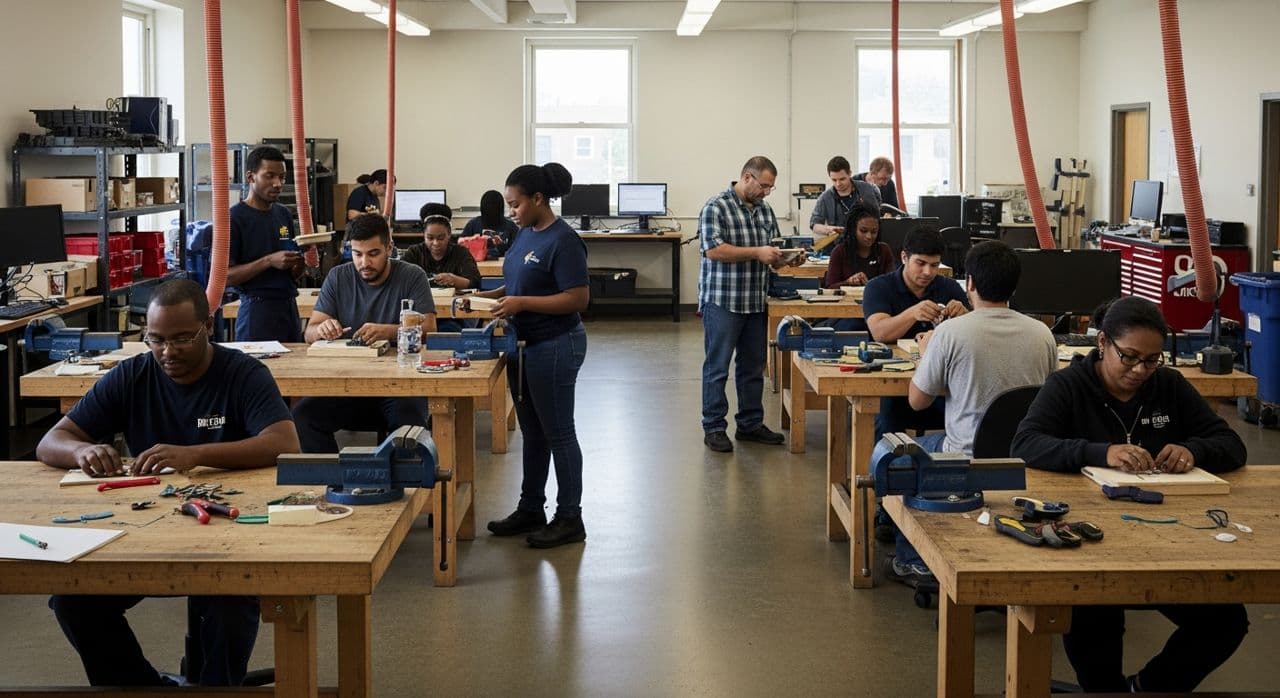
Paid work-based learning through social enterprises, internships, apprenticeships, cooperative roles, and supervised production labs, income while learning.
Work
Participants transition into jobs, apprenticeships, contract and freelance work, social enterprise employment, or career advancement.
Build
Support to launch small businesses, e-commerce ventures, contractor pathways, food businesses, AI-enabled services, and cooperative enterprises.
Own
Participants and communities build ownership through entrepreneurship, worker-owned models, shared service platforms, and community-owned enterprises.
Whole-person assessment
Every participant starts with an Individual Empowerment Plan
Before training begins, a whole-person assessment shapes a personalized plan that addresses skills, income, barriers, and a responsible benefits transition.
- Education assessment
- Career interest assessment
- Employment & income review
- Benefits review
- Transportation needs
- Childcare needs
- Housing stability
- Health & wellness barriers
- Digital literacy level
- Legal / reentry barriers
- Benefits transition plan
- Middle-class capacity goals
Benefits transition planning
The goal is never to move people off assistance prematurely. It's to help families increase earned income, stabilize employment, understand eligibility changes, build savings, and transition responsibly, without triggering a benefit cliff.
National replication model
Five phases to launch a community
The model can be implemented through local chapters, school and workforce partnerships, employer networks, and community cooperatives.
Community Readiness
Local needs assessment, partner mapping, public agency alignment, funder engagement, and community leadership identification.
Pathway Design
Select target populations, training sectors, social enterprise opportunities, support partners, and cooperative development priorities.
Pilot Launch
Launch intake, Individual Empowerment Plans, training cohorts, paid work-based learning, support services, and employer pathways.
Community Ownership
Build local cooperative membership, vendor networks, shared services, entrepreneurship, and social enterprise capacity.
Evaluation & Scale
Track outcomes, publish results, refine the model, and expand into additional neighborhoods or regions.
Help build the pathway
Help build a national pathway out of poverty
Funders, policymakers, employers, schools, and community leaders, help expand this model in New Jersey and beyond.